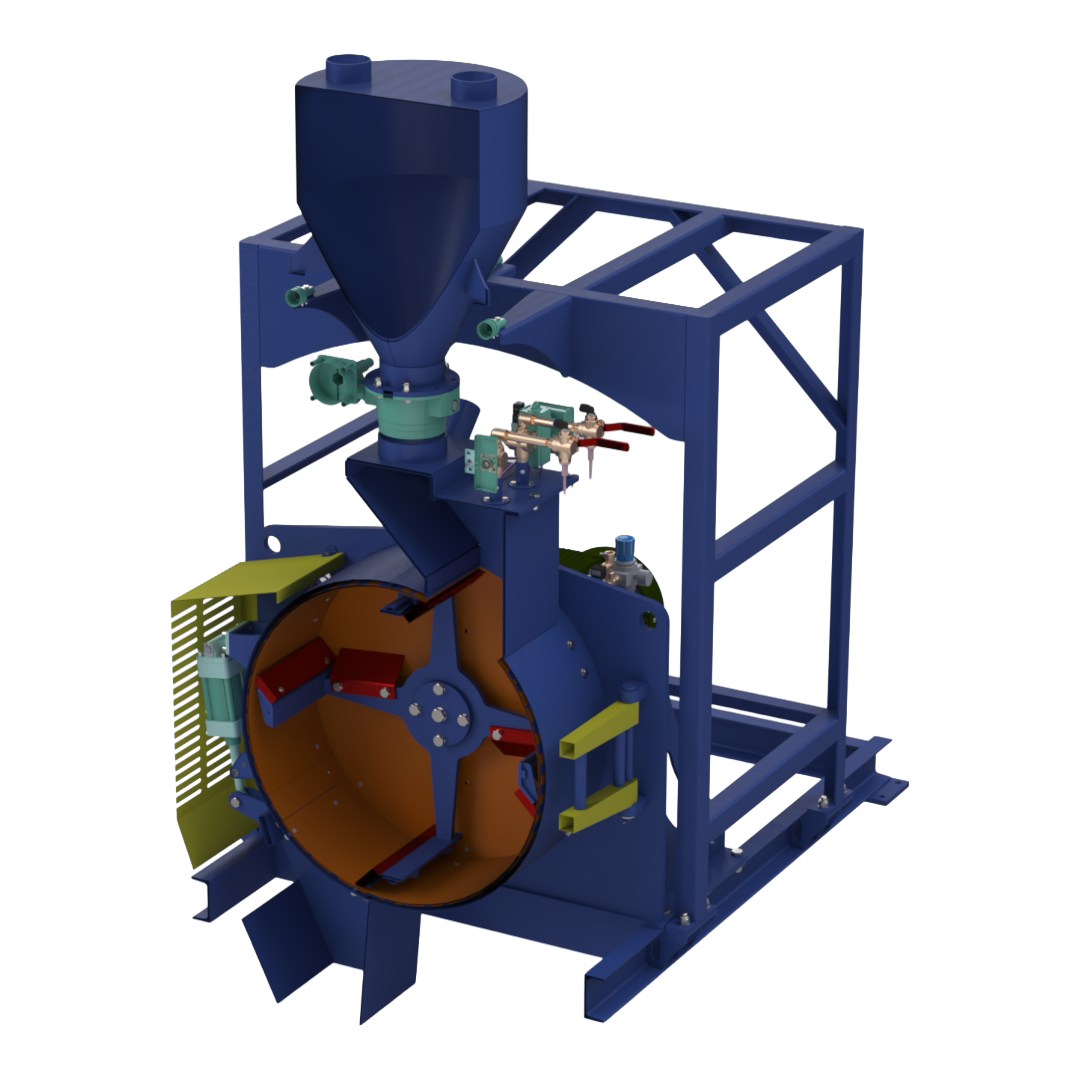
What is Core Sand Mixer
In the foundry industry, core sand mixers play a critical role in producing high-quality cores, which directly affect the durability and dimensional accuracy of the final product. One of the most essential pieces of equipment used in core production is the core sand mixer. Properly mixing sand with binders to achieve an ideal, homogeneous structure and preparing it for the molding process are key functions of core sand mixers. In this article, you will find detailed information covering the operating principles, application areas, and selection criteria of core sand mixers.
Working Principle of a Core Sand Mixer
In core production, sand is combined with various binders and catalysts. This process is carried out through the mixing motions performed by the mixer at specific speeds and patterns.
The basic working principle of a core sand mixer is as follows:
A predetermined amount of dry sand is fed into the mixer chamber.
Resin, binders, or chemical additives are then introduced into the system in a controlled manner.
Depending on its design, the mixer processes the sand using spiral, impact, or kneading mixing actions.
As a result, a homogeneous, smooth, and workable core sand mixture is obtained.
If this process is not performed correctly, several casting defects may occur, including porosity, surface defects, and dimensional distortions.
Advantages of Using a Core Sand Mixer
The use of core sand mixers provides many critical advantages for foundries:
Homogeneous mixing: Mixers ensure perfect and uniform blending of sand and binders.
Time savings: Significantly faster compared to manual mixing.
Consistent quality: Enables continuous production of cores with identical properties.
Reduced material waste: Accurate mixing ratios lower binder consumption.
Improved casting quality: Properly prepared sand minimizes casting defects.
Especially for high-volume production facilities, a core sand mixer is an essential piece of equipment.
What to Consider When Purchasing a Core Sand Mixer
Choosing the right mixer is a critical decision in terms of both cost efficiency and production quality. Before purchasing a core sand mixer, the following factors should be carefully considered:
a) Capacity
The selected capacity should match your facility’s daily core production requirements. Mixers that are too small may be insufficient, while oversized mixers can lead to unnecessary energy and binder consumption.
b) Mixing Type and Homogeneity Rate
The mixing performance of the mixer directly affects production quality. Mixers with a high homogeneity rate should be preferred.
c) Energy Consumption
Mixers that deliver high efficiency with low energy consumption provide significant long-term cost savings.
d) Spare Parts and Service Support
Machines that frequently break down or lack a strong service network can disrupt production. The manufacturer’s service and spare parts support should be thoroughly evaluated.
e) User-Friendly Design
Mixers that are easy to clean and equipped with clear, intuitive control panels help streamline production processes.